

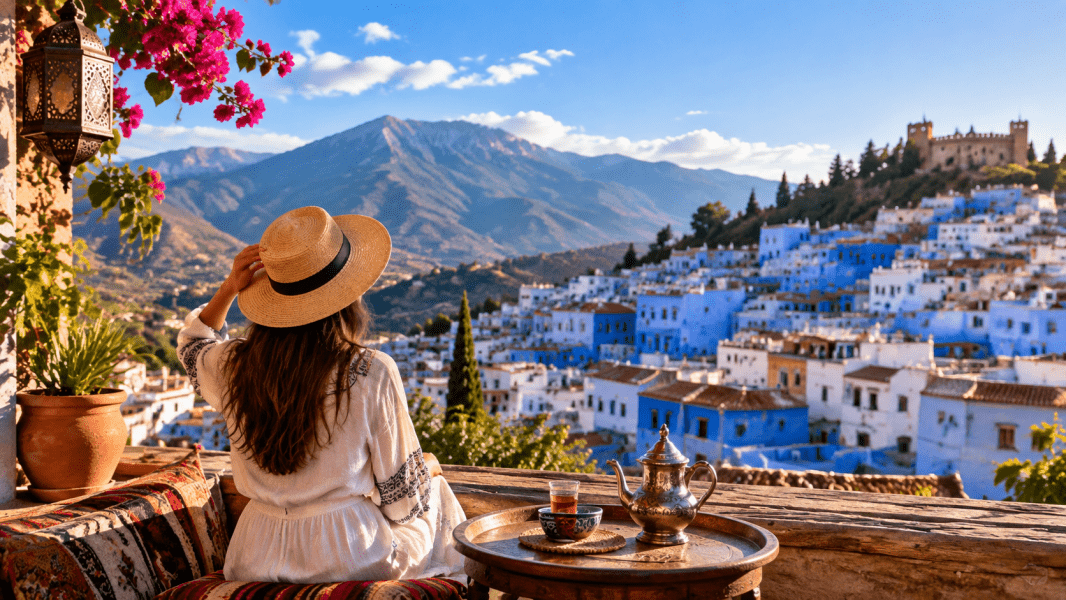
Female looking at view over Chefchaouen, Morocco: Image provided by Moroccotourspot
Morocco has become an increasingly appealing base for remote workers who want a change of scenery without giving up good connectivity, lively cities, easy access to Europe and a strong sense of local culture. One week you can be answering emails from a café in Marrakech; the next, you can spend a weekend by the Atlantic in Essaouira or hiking in the Atlas Mountains.
For digital nomads, the country offers an unusual balance: modern services sit alongside historic medinas, co-working spaces are available in the larger cities, and daily costs can be manageable compared with many Western European destinations. The key is choosing the right base and understanding the practical side of working remotely before you arrive.
Guest author, Moroccotourspost explain.
Does Morocco Have a Digital Nomad Visa?
No, Morocco does not have a dedicated digital nomad visa, but there are options to live, work and play in Morocco if you are a digital nomad. These include:
- Visa-Free Tourist Entry: Citizens of over 60 countries (including the US, UK, EU, Canada, and Australia) can enter Morocco visa-free for up to 90 days. While working remotely for a foreign employer on a tourist entry exists in a legal grey area, it is widely used by short-term remote workers without issue.
- Border Runs: Many nomads extend their stay by leaving the country (often taking a quick ferry to Spain) and re-entering after their 90-day tourist stamp expires to reset the allowance.
- Carte de Séjour (Residency Card): For long-term stays, remote workers can apply for a standard residency permit. This typically requires proof of accommodation, sufficient financial means, and sometimes registering locally as a self-employed person (auto-entrepreneur).
Entry Rules, Work Status and Taxes
This is the area where remote workers should avoid assumptions. Morocco’s official tourism information states that visa requirements depend on nationality and that the maximum tourist trip is 90 days. A tourist stay is not automatically the same thing as permission to take local employment or carry out every type of professional activity.
Moroccan consular information lists several visa categories, including short-stay and long-validity visas. If you plan to remain for an extended period, work for a Moroccan company, run a local business or become tax-resident, get advice that matches your nationality, employer and length of stay. Remote-work arrangements can have immigration, employment and tax implications even when your clients or employer are abroad.
Choosing the Right Moroccan City for Remote Work
There is no single best Moroccan city for every remote worker. Your ideal base depends on whether you value fast-paced city life, the coast, nightlife, walkability or a quieter routine.
Marrakech is the obvious choice for people who want energy, restaurants, accommodation options and an active international scene. It is also well connected by air, making it convenient for short trips in and out of the country. The medina can be intense, so longer-stay nomads often prefer neighborhoods such as Gueliz or Hivernage for easier day-to-day living.
Casablanca suits remote workers who prefer a large business city with modern services and transport connections. It is less focused on tourism than Marrakech and can feel more practical for a longer stay. Rabat, by contrast, is calmer, greener and more orderly, which makes it attractive if you want a quieter workweek without giving up urban comforts.
For a slower rhythm, Essaouira is one of the most appealing options. The compact coastal city has a relaxed atmosphere, strong café culture and an international community. Tangier also deserves consideration, especially for nomads who want a Mediterranean feel and quick access to northern Morocco.
Internet, SIM Cards and a Reliable Work Setup
Internet quality is generally strongest in major cities and established tourist areas. Many apartments, riads, hotels and coworking spaces advertise Wi-Fi, but speed and reliability can vary from one property to another. If your job depends on video calls or large uploads, ask for a recent speed test before booking a long stay.
A local SIM card is useful even if your accommodation has excellent Wi-Fi. Mobile data gives you a backup connection and makes maps, ride apps and messaging easier when you are away from your desk. For an important meeting, it is sensible to keep mobile data available as a hotspot in case the fixed connection drops.
Remote workers who need quiet calls should also think about noise. A beautiful riad inside a medina may be perfect for a holiday but less practical for a full working week if your room faces a busy courtyard. Newer apartments or dedicated co-working spaces can be easier for structured workdays.
Check out Booking.com for accommodation options.
Co-working and Café Culture
Morocco’s larger cities now have a growing number of co-working spaces, particularly in Marrakech, Casablanca, Rabat and Tangier. They can be a good option if you need dependable Wi-Fi, meeting rooms or simply a reason to separate work from your accommodation.
Cafés are also part of everyday life, but not every café is designed for someone to occupy a table with a laptop for several hours. Choose places with enough space, order regularly and be respectful during busy periods. For confidential meetings or calls, a co-working booth or private room is usually a better choice.
Accommodation for a Longer Stay
For a stay of several weeks, location matters more than having a highly photogenic room. Look for practical features: a proper desk, comfortable chair, natural light, heating or air conditioning for the season, a washing machine and nearby grocery shops. In larger cities, an apartment in a modern neighbourhood can offer a smoother routine than changing hotels every few days.
Before paying for a long booking, check exactly what is included. Electricity, water, cleaning and internet are not always handled the same way in every rental. It is also worth reading reviews specifically for comments about Wi-Fi, street noise and hot water rather than focusing only on the décor.
Cost of Living and Everyday Payments
Your budget can vary widely depending on the city and your travel style. Local cafés, neighbourhood restaurants and public transport can keep daily spending modest, while boutique accommodation, rooftop restaurants and frequent private transfers can increase costs quickly. Marrakech and Casablanca tend to be more expensive than smaller cities, although there is a broad range of options in both.
Cash remains useful for small shops, traditional markets and some taxis. International cards are accepted by many hotels, restaurants and larger businesses, and ATMs are widely available in cities. Keep more than one payment method and avoid relying on a single card.
Getting Around Morocco While You Work
One of the advantages of using Morocco as a temporary base is that weekend travel is relatively easy. Trains connect major northern and central cities, including Tangier, Rabat, Casablanca, Marrakech and Fez, while long-distance buses reach many destinations beyond the rail network. Domestic flights can save time when crossing larger distances.
You may have it in your mind the things you want to see and do and experience while living and working in Morocco, but here is some inspiration.
A Sensible Weekly Routine
The biggest mistake many new digital nomads make is trying to travel at holiday speed while maintaining a full workload. Morocco rewards slower travel. Choose one city as your base, establish a predictable work schedule and use evenings or weekends for exploring.
· Monday to Thursday: keep regular work hours and stay close to your base.
· Friday: finish earlier if possible and travel to a nearby destination.
· Saturday: explore without carrying your laptop everywhere.
· Sunday: return early enough to reset for the working week.
This approach is far less exhausting than changing accommodation every few days, and it gives you time to experience ordinary local life rather than only the highlights.
Local Etiquette That Makes a Difference
Morocco is welcoming, but a little cultural awareness goes a long way. Dress and behaviour can be more conservative than in parts of Europe, particularly outside tourist districts. Ask before photographing people, learn a few basic words in Moroccan Arabic or French, and be patient when communication takes a little longer than expected.
During Ramadan, daily rhythms change significantly. Many people fast from dawn to sunset, working hours may shift and some cafés or restaurants operate differently during the day. Remote workers can still have a comfortable stay, but it helps to adapt respectfully to the local routine.
Final Thoughts
Morocco can work very well for digital nomads who value culture, variety and the ability to combine productive workdays with memorable short trips. Marrakech offers energy, Rabat brings calm, Casablanca provides big-city convenience, and coastal cities such as Essaouira and Tangier offer a different pace altogether.
The best experience comes from planning the practical details first: confirm your internet, choose accommodation that supports your work, understand the rules that apply to your stay and avoid moving too often. Once those basics are in place, Morocco becomes much easier to enjoy as both a workplace and a destination.
More Morocco Inspiration:
7 Days Morocco Itinerary for your first visit
Morocco Highlights – Best things to see and do in Morocco




0 Comments