

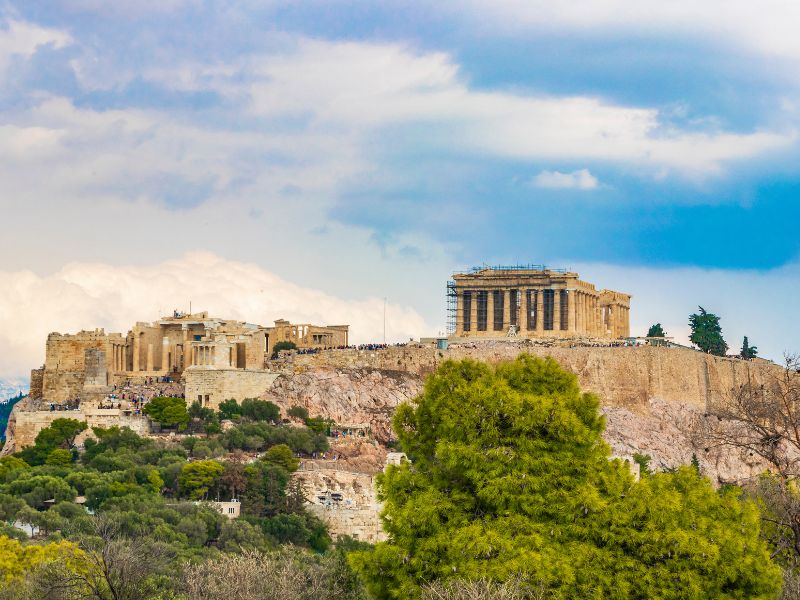
The Acropolis is one of the most recognisable ancient landmarks in the world. Even if you’ve never been to Athens, you’ve probably seen photographs of the Parthenon standing above the city. If you are heading to Athens for a holiday you will want to know how to see and explore the Acropolis in Athens, both fee and paid options.
When you start planning your visit, one of the first questions you might ask is: do I need to buy a ticket to experience the Acropolis? The answer is no. There are free ways to see the Acropolis.
You can see the hill from streets, neighbourhoods and nearby viewpoints without paying anything. However, seeing it from below isn’t the same as walking through the entrance and standing beside the Parthenon, which you will need to pay to do.
You don’t have to choose. I’d use the free viewpoints first, then visit the archaeological site. The outside views show its position above Athens, while entering lets you examine the structures closely.
Here’s everything you need to know about seeing and exploring the Acropolis.
TIP: Get a map and plot your day.
How to See the Acropolis for Free
Because the Acropolis stands above central Athens, you’ll see it between buildings, above busy squares and from nearby hills. There are a number of free vantage spots to see the Acropolis from different angles. You could visit one or more and this might depend on how your feet are feeling with all the walking. I’d recommend visiting one or two of the free spots before paying to enter the Acropolis. But how you see and visit the Acropolis is totally up to you.
Areopagus Hill
Areopagus Hill, also known as Mars Hill, is one of the closest free viewpoints. The rocky outcrop sits beside the Acropolis and looks towards the citadel and the city below. It’s easy to reach from Plaka and the main pedestrian areas.
The view of the Parthenon is angled, but the closeness of the hill gives you a clear sense of the walls and rocky setting. It becomes busy around sunset, so arrive earlier for more room.
The surface is smooth and can be slippery, particularly after rain. Wear shoes with good grip. Areopagus is one of several historic hills surrounding the Acropolis.
Philopappos Hill
Philopappos Hill provides one of the clearest full views of the Acropolis. The hill lies southwest of the site and has trees, paths and several places where the Parthenon appears above the landscape. It usually feels more spacious than Areopagus Hill.
I’d visit in the late afternoon. From this side, you can see the shape of the hill, its walls and the monuments along the summit. Begin heading back before it becomes fully dark because lighting is limited on some paths.
The official Athens guide also identifies Philopappos Hill as one of the city’s main viewpoints over the Acropolis and Athens.
Pnyx Hill
Pnyx Hill is another free viewpoint within walking distance of the Acropolis. In ancient Athens, this was an assembly area where citizens gathered for speeches and public decisions. Today, it offers a quieter view towards the Acropolis.
It isn’t as high as Philopappos Hill, but fewer people gather here. You can combine it with a walk towards Thissio or the Acropolis pedestrian streets.
Monastiraki Square
Monastiraki Square gives you a very different view. Here, you’ll see the Acropolis rising above Metro entrances, market streets, shops and restaurants. The square is busy, but that’s what makes the view interesting.
Walk through the surrounding streets and look up. The Parthenon often appears between buildings as you move towards Plaka.
Plaka and Anafiotika
Plaka is the historic neighbourhood beneath the Acropolis. Its streets wind between older buildings, small squares, shops and restaurants. Parts of the Acropolis walls and monuments appear between rooftops, so allow time to wander rather than following the quickest route.
Anafiotika sits on the northeastern slope. Its whitewashed houses and narrow lanes were built by workers from the island of Anafi.
You won’t always see the whole Parthenon, but you’ll be directly beneath the walls. And people live her so it’s appreciated if you keep noise low and avoid spaces that look private.
Dionysiou Areopagitou Street
Dionysiou Areopagitou is the pedestrian street running along the southern side of the Acropolis. Walking here gives you views of the slopes, walls and archaeological areas below the summit. The route also passes near the Acropolis Museum, Theatre of Dionysus and Odeon of Herodes Atticus.
You can follow it towards Thissio, continue to Philopappos Hill or use it to reach an Acropolis entrance. Early evening is a good time, especially during warmer months.
See the Acropolis at Night
The Acropolis is illuminated after dark and can be seen from many parts of central Athens. The pale stone of the Parthenon stands out above the darker hill. You can see it from Monastiraki, Thissio, Plaka and several nearby hills – all the places you may have visited today!
You don’t need to buy a rooftop meal for the view – though this is a wonderful thing to do while visiting Athens. The pedestrian streets and public viewpoints provide plenty of clear angles. I’d try to see it during the day and after dark.
Paid Options for Exploring the Acropolis
To walk around the Parthenon and the other monuments on the summit, you’ll need a timed ticket for the Acropolis and Slopes archaeological site. Opening hours change through the year, and access can be adjusted during extreme heat, so check the official ticketing information before your visit.
Is a Guided Tour of the Acropolis Useful/Worth it?
You can explore the Acropolis independently, particularly if you use the signs, an audio guide or a guidebook. The main buildings are easy to identify, but their connection with one another isn’t always obvious. This is where a guided tour comes in. A guide can explain why the temples were built, how religious ceremonies used the hill and what has changed through damage and restoration. This can be useful when the site feels crowded and you’re unsure where to focus.
A tour isn’t essential, but it can make the scattered remains easier to interpret. I’d consider one when ancient Greek history isn’t familiar to you or when you want to connect the summit with the monuments on the slopes.
The Climb to the Acropolis
Reaching the summit involves walking uphill over stone paths and uneven surfaces. The distance isn’t long, but the heat, crowds and polished ground can make it tiring. There’s limited shade at the top.
Bring water, wear supportive shoes and avoid the hottest part of the day. Visitors with mobility requirements should check current lift and route arrangements before arriving. The Ministry of Culture publishes updated accessibility information and designated routes for the site.
Which Entrance Should You Use?
The Acropolis has more than one entrance. The western entrance is closest to the Propylaea and is often used by visitors arriving from Plaka or Monastiraki. It’s the most direct route, but it can also attract the largest queues.
The southern entrance is near the Acropolis Museum and takes you past sites on the slope before reaching the summit. I prefer this approach when there’s enough time because the climb becomes part of the visit rather than simply a route to the Parthenon.
Whichever entrance you choose, make sure it matches your timed ticket and current access arrangements.
The Propylaea
The Propylaea is the monumental gateway to the summit. You approach it by climbing broad steps between large columns. Parts of the Parthenon begin to appear as you move through. The area becomes congested because most visitors use the same route. Once there, there is a great view across Athens.
What to See inside the Acropolis
There are a number of surviving buildings on the Acropolis – Propylaea, Parthenon, Erechtheion and Temple of Athena Nike.
The Parthenon
The Parthenon is the best-known building on the Acropolis. It was constructed in the fifth century BCE and dedicated to Athena, the city’s patron goddess. Its rectangular form and rows of columns have influenced public buildings around the world.
You can’t enter the temple, but you can walk around the permitted areas outside it. Standing nearby reveals the scale of the columns and the slight adjustments built into the structure.
Note: Cranes or scaffolding may be visible because of restoration work.
The Erechtheion
The Erechtheion stands on the northern side of the Acropolis. It’s smaller and less symmetrical than the Parthenon because it combined several sacred areas. Its best-known feature is the Porch of the Caryatids, where female figures support the roof in place of columns.
The figures outside are replicas, while five originals are in the Acropolis Museum. Take time to view the building from more than one side because the porches and levels are arranged differently.
The Temple of Athena Nike
The Temple of Athena Nike stands near the Propylaea at the edge of the Acropolis. It’s much smaller than the Parthenon, but its raised position makes it noticeable from below. Because it sits beside the crowded entrance, many visitors overlook it. Look back after entering the summit, when you may have a clearer view.
Access can change during conservation work, so follow the marked visitor route.
Get Views Across Athens
The monuments are the main reason to enter, but the views from the summit also help you understand the location.
From the Acropolis, Athens spreads towards the mountains and, on a clear day, the coastline. On a clear day you may identify Mount Lycabettus, the Temple of Olympian Zeus, the Ancient Agora, Philopappos Hill and the Odeon of Herodes Atticus. Looking down also shows how closely modern streets surround the ancient areas. Pretty spectacular if you ask me!
The Southern Slope
The southern slope includes the Theatre of Dionysus and the Odeon of Herodes Atticus, showing how the area was connected with performance and public gatherings.
The Theatre of Dionysus is linked with ancient Greek drama, while the Odeon is a later Roman theatre that’s still used for performances. You’ll generally view it from the archaeological route unless you’re attending an event.
The Acropolis Museum
The Acropolis Museum is a separate attraction near the southern entrance and requires its own ticket. Its official site publishes separate opening hours and admission information.
The museum contains sculptures, architectural pieces and objects found around the Acropolis, including five original Caryatids. The gallery was specifically designed to display the Parthenon’s surviving sculptural decoration.
I’d visit after the archaeological site because seeing the monuments first makes the displays easier to understand.
How long to Budget to See and Visit the Acropolis?
It depends on your interest and time available as to how long to spend discovering the Acropolis. I would suggest a couple of hours walking around the city seeing it from different spots. Then, a couple of hours inside the Acropolis. And I would make time at night to see it also.
If you are worried if there is a good time to avoid other tourists – well, there is always going to be tourists!
Which Acropolis Experience Should You Choose?
If you’re traveling on a strict budget, you can still experience the Acropolis without entering and so, you will see the Acropolis for free from the streets in Athens.
Walk through Plaka and Anafiotika, follow Dionysiou Areopagitou Street and view the hill from Areopagus, Pnyx or Philopappos. Return after dark to see the Parthenon illuminated above Athens.
These free options work well when you’re short on time or mainly interested in how the Acropolis sits within the city.
Paying for entry is worthwhile when you want to examine the monuments and understand their arrangement. Standard admission is enough for most first-time visitors, while the museum adds context through original sculptures and objects.
Enjoy your visit to Athens and the Acropolis.
Discover more of Greece on a one month island hopping holiday.




0 Comments